
Proper garden drainage is a non-negotiable for healthy plants,stable foundations,and a usable outdoor space—poor drainage leads to waterlogged soil,root rot,mosquito breeding,and even structural damage to home foundations.Corrugated pipes have emerged as the go-to solution for residential garden drainage,thanks to their flexibility,durability,and ability to handle soil movement that would crack rigid pipes.Not all corrugated pipes are equal,though;choosing the right type depends on your specific drainage needs,soil conditions,and installation environment.
First,the most critical distinction is between perforated and non-perforated corrugated pipes.Perforated pipes(often called French drain pipes)are designed to absorb groundwater and surface water from the surrounding soil,making them ideal for sub-surface drainage applications.They feature small holes or slits along their length,strategically placed to let water enter while minimizing soil intrusion.Non-perforated pipes,by contrast,are solid-walled,and their only job is to carry collected water away from the garden area to a safe outlet—such as a storm drain,dry well,creek,or sloped area where water can disperse.For example,a waterlogged lawn low spot will require perforated pipe buried under 12–18 inches of gravel,while connecting that drain to your home’s downspout system needs non-perforated pipe to channel runoff far from the foundation.
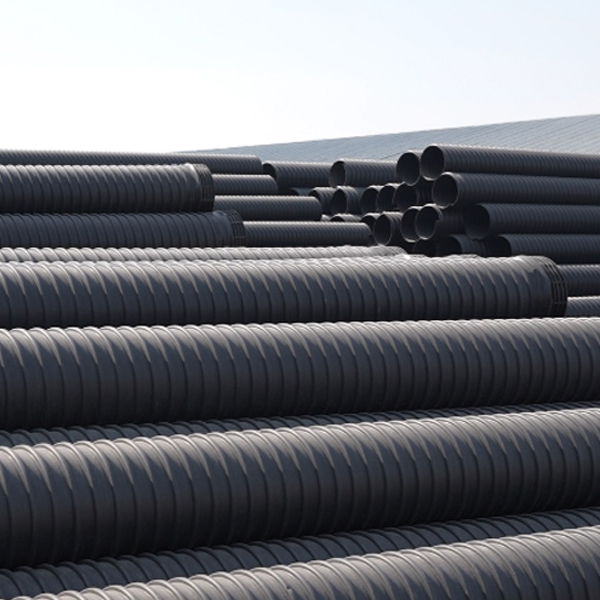
Next,material choice is make-or-break for long-term performance.The best option for garden drainage is high-density polyethylene(HDPE)corrugated pipe,which outperforms older materials like galvanized steel,standard PVC,and low-density poly(LDPE)corrugated pipe.Galvanized steel corrugated pipe rusts over time,leading to clogs and structural failure within 5–10 years,especially in acidic garden soil.Standard rigid PVC is inflexible,making it prone to cracking during soil settling or freeze-thaw cycles,and it’s heavier to maneuver.LDPE corrugated pipe is lightweight but low-duty,easily crushed by backfill or soil pressure.HDPE,by contrast,is UV-resistant(for above-ground use if needed),flexible enough to bend around garden obstacles like tree roots or rocks,strong enough to handle compaction from walking or heavy backfill,and has a lifespan of 50+years.It also has a smoother inner wall than many old corrugated materials,reducing friction and preventing clogs.
When selecting HDPE corrugated pipe,you’ll also need to choose a gauge(or weight class)that matches your project.Light-duty HDPE is designed for shallow,low-pressure applications like small-scale downspout extensions,but it’s too flimsy for deep trenches or areas where backfill will be compacted.Medium-duty HDPE,rated for depths up to 3 feet and light to moderate soil pressure,is ideal for most residential garden projects—like French drains under flower beds or low lawn areas.Heavy-duty HDPE,built for depths over 3 feet or areas with heavy traffic(such as near driveways or patios),is the best choice for high-stakes drainage,as it resists collapse even when buried under multiple feet of soil or construction materials.
Sizing is another key factor to avoid underperforming drains.For small to medium gardens(up to 1,000 square feet of drainage area),a 4-inch diameter pipe is sufficient;it balances flow rate and ease of installation for DIY projects.For larger gardens,low-lying yards that collect heavy rainfall,or areas with steep slopes that accelerate runoff,a 6-inch diameter pipe is better,as it can handle higher water volumes without clogging easily.Always account for the required slope:corrugated pipes need a 1–2%downward slope(about¼inch per foot)to ensure water flows away efficiently,so adjust your pipe length and diameter accordingly to maintain this gradient without pooling.
この Web サイトでは、お客様に最高のエクスペリエンスを提供するために Cookie を使用しています。

 English
 Pусский
 한국어
한국어 中文
中文



 電話
電話
コメント
(0)